
A bipartisan Texas House hearing exposed the growing conflict between parental authority, Big Tech’s addictive products, and the proper limits of government in addressing online harms.

A teenage girl sat across from pediatric psychologist Dr. Daniel Flint and estimated that she spent ten hours a day looking at her phone.
Then she checked the actual number.
It was fourteen hours.
Even if she were sleeping eight hours every night, and Dr. Flint doubted that she was, that left only two hours of her day for schoolwork, family, friendships, exercise, meals and everything else that constitutes life in the real world.
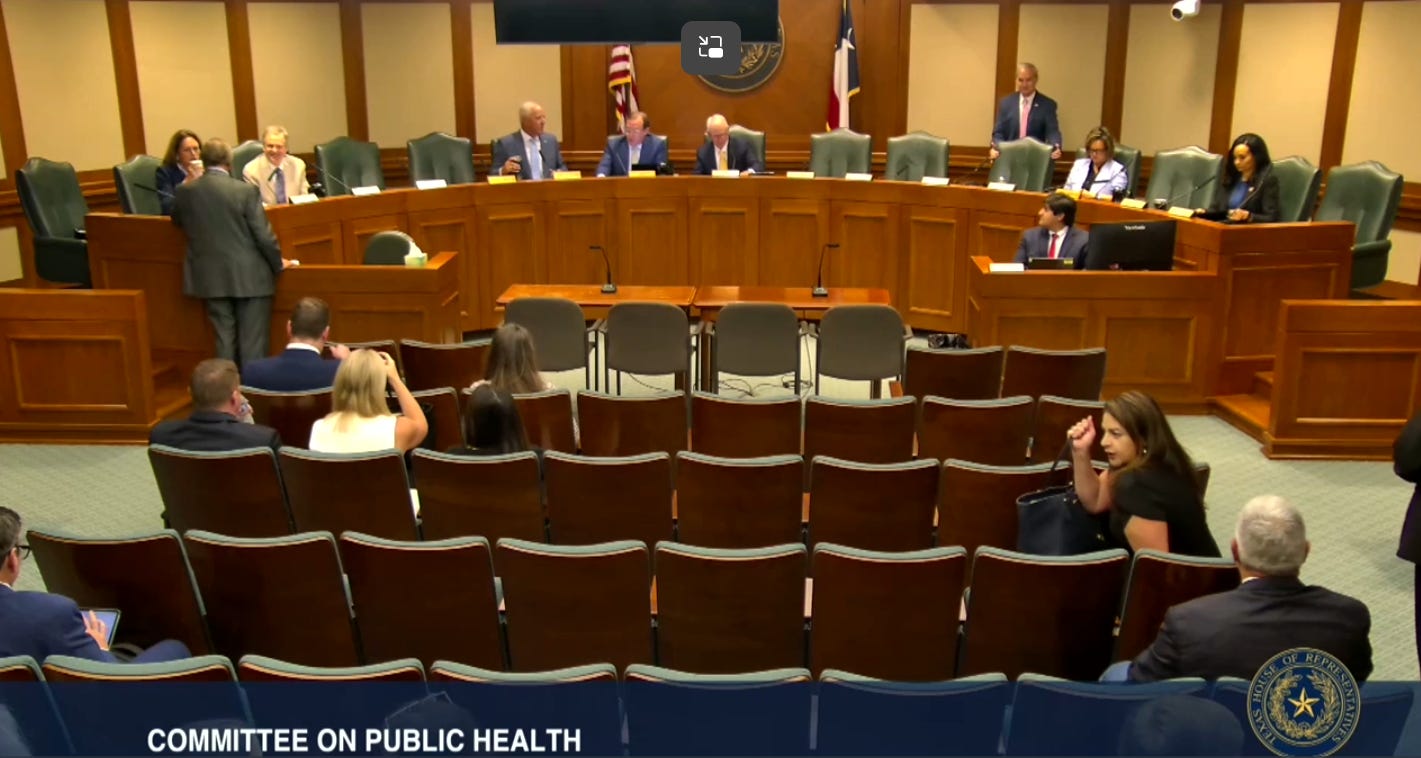
This was one of the stories Dr. Flint shared with the Texas House Committee on Public Health during an August 20 interim hearing examining the effects of social media and artificial intelligence on minors.
His conclusion was blunt:
“You simply cannot out-parent an algorithm.”
That statement captures the dilemma facing families across Texas and across the country.
Parents are told to monitor screen time, activate parental controls, inspect hidden accounts, understand every new platform and stay one step ahead of children who often know the technology better than they do.
Meanwhile, the world’s largest technology companies employ engineers, behavioral experts and sophisticated artificial-intelligence systems to study precisely what keeps children watching, scrolling, clicking and returning.
Responsible parenting matters. And as we always say, “parents are the firewall.” But is it reasonable to place the entire burden on individual families when the product has been deliberately designed to defeat restraint?
And if government intervenes, can it protect children without also undermining parental authority, privacy and constitutional freedom?
This Was More Than an Informational Hearing
The committee was not considering a specific bill. This was an interim hearing intended to gather information and develop recommendations ahead of the 2027 legislative session.
But the discussion went far beyond acknowledging that children spend too much time online.
Lawmakers openly discussed prohibiting minors from using social media, requiring parental approval for online accounts, disabling personalized algorithms, restricting addictive product features and establishing new safeguards for artificial intelligence chatbots.
More significantly, support for stronger restrictions was not confined to one political party.
Democratic Representative John Bucy said he had initially opposed Representative Jared Patterson’s effort to prohibit minors from holding social-media accounts. Bucy believed it should remain a parental decision.
After studying the effects on children, however, he told the committee:
“I’ve really become a convert.”
Bucy said he had come around to supporting an “all-out ban” for minors and compared social media’s effects to the dangers associated with drugs and other harmful substances.
That is a notable political development.
In 2025, the Texas House passed Patterson’s HB 186 by a vote of 116–25. The proposal would have prohibited minors from creating social-media accounts, required platforms to verify users’ ages and allowed parents to request that their children’s accounts be deleted. The measure ultimately died without receiving a final vote in the Texas Senate.
The August hearing made one thing clear: the issue is not going away.
A Developing Brain Against a Profitable Algorithm
Flint, a pediatric psychologist at Texas Children’s Hospital and an assistant professor at Baylor College of Medicine, described what he encounters while treating teenagers.
Adolescent brains are particularly vulnerable to immediate rewards. The areas associated with reward-seeking develop before the regions responsible for judgment and impulse control. Flint summarized the problem by describing teenagers as having plenty of gas but not enough brakes.
Social-media platforms know this.
Features such as infinite scroll, autoplay, push notifications, personalized recommendations and public displays of likes are not incidental decorations. They are part of a product architecture designed to prolong engagement. The longer users remain on a platform, the more data the company collects and the more advertising it can sell.
For vulnerable children, however, the cost may be measured in something other than revenue.
Flint testified about young patients dealing with loneliness, depression, anxiety, disordered eating, sleep deprivation, low self-worth and suicidal ideation. He described a teenager whose momentary interest in an image of self-harm taught an algorithm to send her more of the same material.
Her feed reportedly became increasingly saturated with self-harm and pro-eating-disorder content. What began with curiosity eventually contributed to a medical crisis.
This does not establish that social media is the sole cause of every mental-health problem affecting young people. Children’s well-being is influenced by family circumstances, biology, trauma, schools, communities and many other factors.
But it would be equally irresponsible to pretend that a product capable of studying a child’s behavior and exploiting individual vulnerabilities has no meaningful role in the crisis.
Flint described teenagers who do not even appear to enjoy the hours they spend scrolling:
“They don’t even like it. They just can’t not do it.”
Should Texas Ban Social Media for Minors?
An outright prohibition has obvious appeal.
We restrict children’s access to alcohol, tobacco, gambling and other products because minors lack the maturity to evaluate certain risks. If social-media platforms are deliberately engineered to create compulsive behavior and are associated with serious harm, why should they be treated differently?
A prohibition could also solve what researchers call the network effect. Parents who keep their children off social media may still watch them become socially isolated because everyone else in their peer group is online.
A common rule could relieve children of the pressure to participate.
But an outright ban also raises serious questions.
Social media is not alcohol or tobacco. It is also a medium through which people communicate, obtain information, participate in politics and exercise constitutional rights.
Any law restricting access will face First Amendment challenges. Several state online-safety laws have already become tied up in litigation.
Age verification introduces another problem: privacy.
A system cannot determine whether a user is a minor without obtaining or inferring information about that person. Depending on how a law is written, Texans could be asked to provide government identification, biometric information, credit-card data or other sensitive details simply to access lawful speech.
Protecting children should not require building a centralized record of what every Texan reads, watches or says online.
Enforcement matters too. Children will find workarounds. Platforms will search for loopholes. Poorly drafted definitions could sweep in news websites, educational resources, religious communities or other services that lawmakers never intended to regulate.
These concerns do not justify doing nothing. They demonstrate why the details matter.
The Surveillance Trap
Every proposed solution must confront an uncomfortable fact: a platform cannot apply special rules to children unless it first determines who the children are.
An age-based social-media prohibition requires platforms to verify, or at least estimate, the age of every person attempting to create an account. Parental-consent requirements go further by requiring someone to establish not only that a user is a minor, but also that another verified person is legally authorized to act as that child’s parent or guardian.
That could mean collecting government identification, credit-card information, biometric data, device-level signals or details about family relationships.
Calling this “age assurance” rather than “age verification” does not eliminate the surveillance. A system that estimates age by analyzing a face, voice, browsing history, social connections or online behavior may be less transparent and more invasive than one that checks an identification document.
The same problem applies to AI chatbots. Requiring a chatbot to detect suicidal ideation, sexual conversations or dangerous emotional dependency may sound sensible, but detection requires the system to inspect and classify private conversations. Protecting a child from one form of exploitation could normalize another form of monitoring.
Even parental-access requirements carry risks. Before a company gives an adult access to a child’s account, it must verify the adult’s identity and legal relationship to the child. A poorly designed system could expose children’s private information to abusive parents, estranged family members, identity thieves or government investigators.
This is the surveillance trap at the center of the youth-online-safety debate:
To prohibit minors from using a platform, the platform must identify minors.
To verify parental consent, it must identify and connect children with adults.
To detect harmful conversations, it must examine those conversations.
To provide personalized safety interventions, it must continue profiling users.
To enforce these requirements, government must be able to audit or compel access to the resulting systems and records.
Texas should not pretend these are minor implementation details. They are fundamental civil-liberties questions.
Start by Collecting Less, Not More
The goal should not be to construct a more benevolent surveillance system. It should be to reduce the amount of surveillance built into the product in the first place.
That begins with restricting business practices rather than demanding that platforms develop even more sophisticated systems for identifying and monitoring users.
Texas lawmakers should consider principles such as:
Companies should collect only the information necessary to provide the service a user requested.
Behavioral data should not be collected merely to maximize the time a person spends on a platform.
Sensitive data should not be retained indefinitely or sold to third parties.
Platforms should clearly disclose how recommendation systems operate and what information affects a user’s feed.
Independent researchers and regulators should be able to examine aggregate platform risks without receiving individual users’ identities or private communications.
Companies should face consequences when they knowingly misrepresent safety features or conceal internal evidence of foreseeable harm.
Any age-verification mandate should state precisely what information may be collected, prohibit its use for advertising or unrelated purposes, require prompt deletion and provide a private remedy when information is misused.
Government agencies should not receive access to age-verification records, browsing histories or private communications without constitutionally sufficient legal process.
Any law should contain firm limits, public reporting requirements and an expiration date requiring lawmakers to reconsider whether the policy worked and what privacy costs it created.
Some design rules could apply universally rather than requiring platforms to divide every user into child and adult categories. Platforms could be required to offer chronological feeds, disable autoplay or allow users to turn off personalized recommendations without first proving their age.
That would preserve adult choice while reducing dependence on identity verification.
But universal rules carry their own tradeoff: government would be regulating how adults use lawful products. There is no option that eliminates every cost.
No Easy Answer
The choice is not between protecting children and doing nothing.
The real choice is among competing risks:
exposing children to products engineered for compulsion;
creating an identification system for lawful online speech;
monitoring private communications in the name of safety;
empowering parents while collecting sensitive family information; or
imposing universal product restrictions that also affect adults.
A serious policy must state which risk it is addressing, which new powers it creates and who could misuse those powers later.
Texas should be deeply skeptical of companies that profit from tracking children. It should be equally skeptical of any government solution that requires tracking everyone else.
Protecting children cannot mean constructing the infrastructure for universal digital identification. Nor should parental rights become a slogan used to excuse corporations that deliberately undermine parental authority.
The first principle should be simple: collect less data, retain less data and create fewer systems capable of monitoring lawful behavior.
If a proposed child-safety law requires more surveillance than the product it is supposed to regulate, lawmakers should return to the drawing board.
Join the Coalition
Help us protect children, preserve parental authority, and defend privacy in the digital age. Join the PKO Coalition and add your voice to the fight for responsible, constitutional online-safety policy.
